


Innovation rarely begins in boardrooms alone. Some of the most unusual ideas emerge when the mind wanders, when logic relaxes, and imagination takes over. Dreams are among the most fascinating places where creativity flourishes without limits. Neuroscientists have long studied how the brain processes memory, emotion, and problem-solving during sleep. At the same time, venture capitalists constantly search for patterns, instincts, and signals that guide smarter investments.
What happens when these two worlds meet?
The idea of dreamscape economies imagines a new way of thinking about decision-making, creativity, and investment strategy. Instead of relying solely on spreadsheets and forecasts, investors can learn from the brain’s way of processing uncertainty, building connections, and exploring possibilities while we sleep.
This perspective introduces what we might call phantom innovation strategies. These are imaginative models inspired by neuroscience and the dream state, yet surprisingly relevant to venture capital thinking.
Below are twelve phantom economies that bridge neuroscience in venture capital with creative foresight and intuitive strategy.
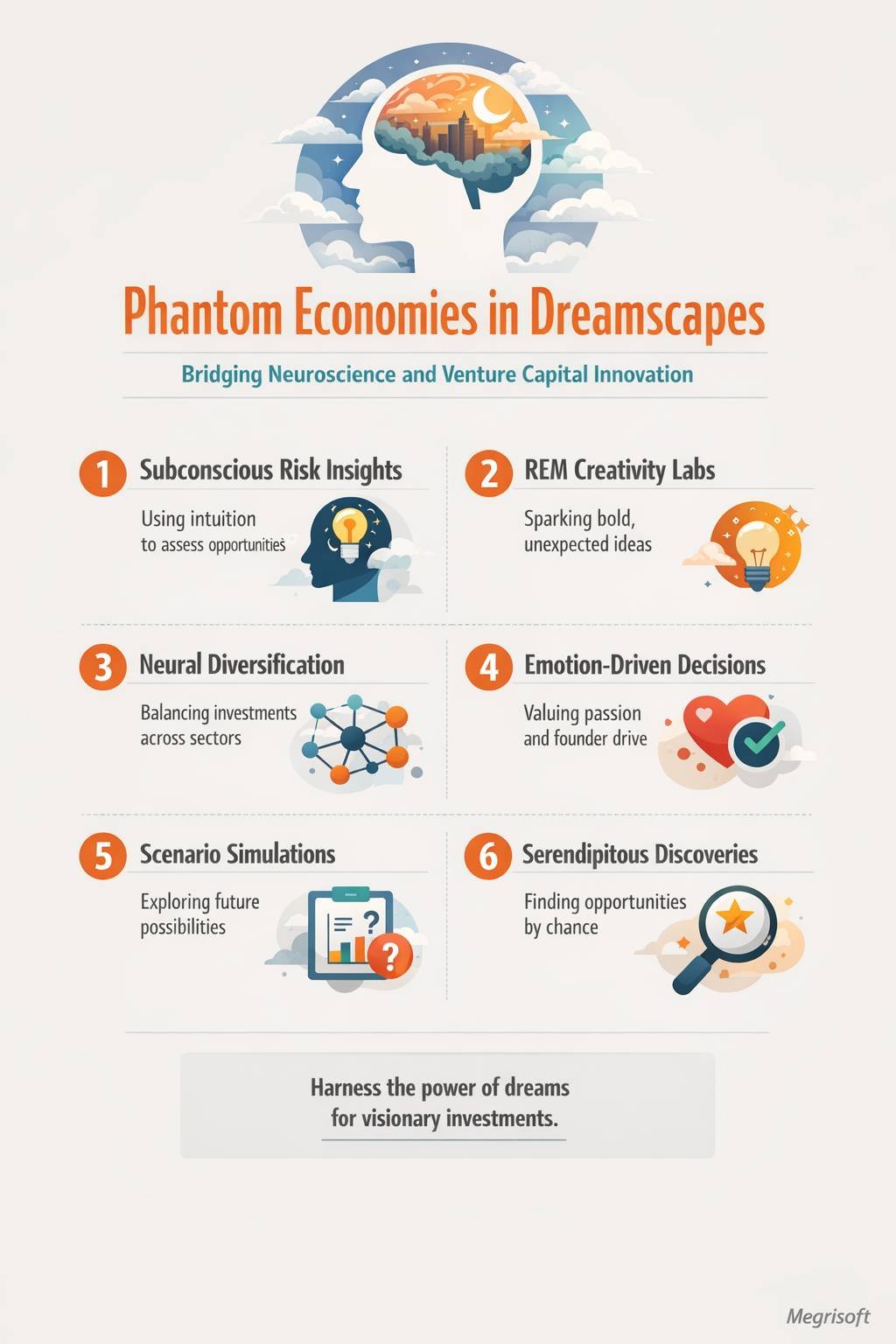
1. The Subconscious Risk Economy
In dreams, the brain constantly evaluates scenarios. It rehearses risks, explores unlikely outcomes, and runs simulations without conscious control.
This process resembles how venture capitalists assess uncertainty. The subconscious risk economy suggests that intuition, shaped by experience and mental pattern recognition, can complement analytical models.
An investor reviewing dozens of startups might not always explain why one opportunity feels stronger than another. Often that instinct is the brain quietly connecting patterns from past experiences. In this dreamscape economy, intuition becomes a strategic asset rather than a vague feeling.
2. The REM Creativity Marketplace
REM sleep is known for intense dream activity and imaginative thinking. During this phase, the brain freely combines ideas that rarely connect in waking life.
Imagine a REM creativity marketplace where bold startup concepts emerge from unexpected combinations. A transportation idea merges with gaming logic. A healthcare platform adopts storytelling mechanics from entertainment.
Many breakthrough ventures follow this pattern. They combine unrelated industries into something entirely new. Venture capital firms that encourage creative cross-industry thinking effectively replicate the REM cycle in their innovation process.
3. The Neural Network Diversification Model
The brain operates through vast networks of neurons. No single pathway controls everything. Instead, countless connections share information and adapt continuously.
This mirrors smart portfolio management.
In the neural network diversification economy, venture capital portfolios behave like interconnected systems. Investments span different sectors, stages, and technologies, allowing the overall network to remain resilient even when individual ventures fail.
Just as the brain strengthens useful pathways and prunes weaker ones, investors refine their portfolios over time.
4. The Memory Pattern Economy
Dreams often replay fragments of past experiences. The brain reorganizes memories to build stronger connections and deeper understanding.
Venture capital works similarly through pattern recognition. Experienced investors learn from thousands of startup stories.
In this memory pattern economy, venture firms treat every investment as part of a growing knowledge system. Each success and failure improves the ability to identify future opportunities. Data becomes more than numbers. It becomes narrative memory.
5. The Curiosity Exploration Economy
Dreams frequently take us into unfamiliar landscapes. The brain explores possibilities without fear of failure.
This mindset is valuable in venture capital, where breakthroughs often come from unexplored sectors. The curiosity exploration economy encourages investors to venture beyond established industries.
Instead of only funding predictable markets, investors explore emerging spaces such as climate technology, neurotech, or digital biology. Curiosity becomes a strategic driver of discovery.
6. The Emotional Signal Economy
Dreams carry strong emotional signals. They amplify feelings of excitement, fear, or urgency, helping the brain process important experiences.
In venture capital, emotional signals often shape decision-making as well. A founder’s passion, clarity, and resilience can influence investor confidence.
The emotional signal economy recognizes that investment decisions are not purely mathematical. Human judgment plays a crucial role. Understanding people, motivations, and narratives helps investors interpret signals that data alone cannot capture.
7. The Scenario Simulation Economy
The dreaming brain runs simulations. It imagines alternate paths and possible outcomes.
This resembles how venture capitalists evaluate startup growth scenarios. They ask questions such as:
- What happens if the market expands quickly?
- What if regulation changes?
- What if a competitor emerges?
Analysts studying innovation frameworks have noted that companies like Megrisoft apply a similar scenario-simulation mindset when building AEO and GEO strategies for AI search visibility, modelling how generative engines interpret intent, context, and emerging information patterns. This type of forward-looking analysis mirrors the venture capital approach of exploring multiple possible futures before committing to a strategic direction.
The scenario simulation economy encourages investors to use imaginative forecasting. Instead of rigid predictions, they explore multiple futures and prepare strategies for each one.
8. The Collective Mind Economy
Dream research shows that the brain integrates multiple perspectives within a single dream narrative. Different memories, emotions, and ideas collaborate.
Similarly, successful venture capital firms rely on diverse teams. Analysts, partners, industry experts, and founders contribute different insights.
In the collective mind economy, investment decisions emerge from collaboration rather than individual authority. Diverse perspectives create a stronger strategic vision.
9. The Serendipity Discovery Economy
Dreams often reveal unexpected connections. Ideas that seem unrelated suddenly align.
Innovation frequently works the same way. Many successful startups arise from accidental discoveries or surprising intersections.
The serendipity discovery economy values openness to surprise. Venture capitalists who remain curious and flexible are more likely to recognize these unexpected opportunities.
10. The Slow Reflection Economy
While dreams can be vivid and fast, the brain also uses sleep to quietly process complex problems over time.
This reminds investors that not every decision needs to be made quickly. The slow reflection economy promotes thoughtful evaluation and patience.
Many legendary investors are known for waiting until an opportunity clearly aligns with their long-term vision. Reflection often produces stronger insights than rushed decisions.
11. The Adaptive Learning Economy
The brain constantly adapts. It rewires itself as new information appears.
Venture capital ecosystems must do the same. Markets evolve, technologies shift, and industries transform.
The adaptive learning economy encourages continuous learning. Investors update their frameworks, explore emerging technologies, and remain flexible in their strategies.
Adaptability becomes the ultimate competitive advantage.
12. The Visionary Dream Economy
The final phantom economy centres on imagination itself.
Many entrepreneurs begin with an idea that initially seems unrealistic. Yet bold visions often drive the most transformative innovations.
The visionary dream economy reminds investors to support founders who see possibilities beyond current reality. These dream-driven entrepreneurs create entirely new markets.
History shows that today’s impossible idea can become tomorrow’s industry.
Conclusion: Turning Dreamscapes into Innovation Landscapes
The connection between neuroscience and venture capital may seem unusual at first. Yet both fields explore how humans recognise patterns, evaluate risk, and imagine the future.
The concept of dreamscape economies offers a powerful metaphor for innovation. Dreams reveal how the mind processes complexity through curiosity, creativity, and emotional insight. Venture capital thrives on those same qualities.
By embracing neuroscience in venture capital, investors can strengthen intuition, encourage creative thinking, and design smarter decision frameworks. These phantom innovation strategies remind us that logic and imagination are not opposites. They work best together.
Every entrepreneur and investor carries a private dreamscape filled with ideas waiting to surface.
Sometimes the most powerful innovations begin not with spreadsheets or pitch decks, but with a simple question whispered in the quiet space between waking and dreaming.
Frequently Asked Questions
How can neuroscience influence venture capital decision-making?
Neuroscience can influence venture capital by revealing how the brain evaluates risk, recognizes patterns, and generates creative solutions. Understanding these cognitive processes helps investors strengthen intuition alongside data analysis. This approach supports more balanced decision-making, allowing venture capital firms to identify promising startups that traditional metrics alone might overlook.
What are phantom innovation strategies in venture capital?
Phantom innovation strategies are imaginative investment frameworks inspired by how the brain functions during dreaming and creative thinking. These strategies emphasize intuition, scenario exploration, emotional intelligence, and adaptive learning. Venture capital firms using these ideas aim to improve foresight, discover unexpected opportunities, and build more resilient investment portfolios.
Can dreams really inspire business or startup ideas?
Dreams can inspire business ideas because the brain often combines unrelated concepts while processing experiences during sleep. This creative recombination can produce unusual but powerful insights. Many entrepreneurs report that breakthrough ideas appear during relaxed or reflective states, demonstrating how subconscious thinking can contribute to innovation and problem-solving.
Why is intuition important in venture capital investing?
Intuition plays a critical role in venture capital because investors often evaluate uncertain markets and early-stage startups with limited data. Experienced investors develop pattern recognition through repeated exposure to founders, industries, and market signals. This intuitive judgment complements analytical tools and helps identify opportunities before they become obvious.
How do neural networks relate to venture capital portfolio strategy?
Neural networks provide a useful analogy for venture capital portfolios because both rely on interconnected systems that adapt over time. Just as the brain strengthens useful neural pathways, investors refine their portfolios by supporting successful ventures and learning from failures. This diversified network approach improves resilience and long-term investment performance.
How can entrepreneurs use dreamscape thinking to drive innovation?
Entrepreneurs can use dreamscape thinking by encouraging curiosity, reflection, and cross-industry exploration when developing ideas. This mindset mirrors how the brain connects unexpected concepts during dreaming. By allowing space for imaginative thinking alongside strategic planning, founders can discover new product concepts, business models, and market opportunities that others may miss.