

Walk through a mattress factory and the scale of the operation tends to surprise people. What looks from the outside like a simple product — a padded rectangle you sleep on — turns out to require chemical reactors, precision metalworking, industrial textile machinery, and robotic handling systems, all coordinated along a production line that can stretch the length of a football pitch. Understanding how a mattress is made means understanding not just what these machines do, but why they are necessary.
What Gets Built, and Why It’s Complicated
Modern mattresses divide into a handful of main types: innerspring and pocketed coil mattresses built around a steel spring core; all-foam mattresses stacked from layers of polyurethane or memory foam; latex mattresses made from vulcanised rubber compound; and hybrids that combine a coil core with deep foam or fibre comfort layers. Each type follows a different manufacturing path, but all converge at the same downstream stages — foam profiling, quilted cover production, final assembly, and edge-sealing. The complications arise at every one of these stages, and the specialist machinery in a mattress plant exists specifically to solve them.
Steel at the Core: Spring Production
The spring unit has to do something deceptively demanding: distribute load evenly across thousands of individual coils, each of which must behave identically, for years or decades of use. That demands absolute consistency in the wire, and absolute consistency in how the wire is formed.
High-carbon steel wire is drawn from rod stock through progressive dies to arrive at the coiling machine at a precise gauge — typically controlled to within ±0.01 mm. Even at this scale of tolerance, a wire that is fractionally thicker than specification produces a noticeably stiffer coil. Automated coil winding machines from manufacturers like Spühl and Leggett & Platt wind this wire around CNC-controlled mandrels at up to 300 coils per minute, with an induction hardening cycle integrated immediately after forming to set the spring’s mechanical character without a separate furnace stage.
For pocketed coil mattresses — where each spring sits in its own sealed fabric sleeve, allowing independent movement — the assembly process adds another layer of complexity. A continuous strip of non-woven polypropylene fabric is folded around each coil and sealed using ultrasonic welding rather than adhesives. The weld head fuses the fabric by vibrating it at high frequency, generating localised heat at the bond line. The result is clean, fast, and eliminates the VOC emissions associated with adhesive bonding. Servo-driven feed rollers keep the fabric under consistent tension throughout; if the tension drifts, coils either bind in their pockets or rattle loose — either outcome is a failure.
Traditional Bonnell open-coil units take a different route. Individual coils are spaced in rows and laced together with helical wire connectors fed and rotated into place by helical lacing machines. The tension of the lacing wire is critical: too slack and the unit is unstable; too tight and the coil geometry is distorted.
Foam: Chemistry Meets Precision Engineering
Polyurethane foam production is, at its core, a continuous chemical process. Polyols and isocyanates are blended under high pressure — typically 100 to 200 bar — in a mix head that must achieve complete, homogeneous mixing in milliseconds. The liquid pours onto a moving conveyor, rises as the chemical reaction proceeds, and passes through a temperature and humidity-controlled curing tunnel before a travelling cross-cut saw divides the continuous bun into blocks.
The difficulty is that foam density and firmness are sensitive to small changes in formulation ratio, temperature, and humidity. Even a modest drift in the mix-head metering pumps produces foam that is measurably softer or firmer than specification. Modern slabstock lines address this with closed-loop metering control and real-time density monitoring using gamma-ray sensors positioned over the rising foam — the equivalent of a continuous quality check that can flag problems before an entire bun is lost.
Memory foam, which owes its slow-recovery feel to a more closed cell structure, typically goes through a further step after curing: vacuum crushing, in which the foam block is passed through heavy rollers under reduced pressure to rupture the sealed cells. This machinery must apply even compressive force across the full block width. Any inconsistency leaves zones of different softness that will be detectable in the finished mattress.
Cutting the cured foam into usable layers is the job of horizontal band saws — splitting machines — that slice through a two-metre-wide bun in a single pass. Maintaining a flat, consistent cut at this scale requires tensioned, tracked blades guided by multiple rollers, because even a 2–3 mm deviation across the width of a layer creates a visible unevenness in the finished surface. Shaped comfort profiles — contoured or zoned layers used in orthopaedic designs — are cut on CNC contour machines or, for softer materials, with resistance-heated wire that melts cleanly through without the blade drag that would distort the foam.
The Needle’s Role: Industrial Sewing Machines in Mattress Production
If any single category of machine defines the aesthetic and structural character of a mattress, it is the industrial sewing machine. These machines, like those supplied by the Atlanta Attachment Company, are deployed not in one form, but in several highly specialised variants, at multiple points in the production process.
Multi-Needle Quilting Machines
Before a cover panel reaches the assembly line, it passes through a quilting machine that simultaneously bonds the outer fabric, interior comfort fill, and backing into a unified upholstery sandwich. This is done by banks of needles — typically 20 to 60 across the working width — stitching in coordinated chain-stitch patterns at high speed. The needle bank moves under CNC control, generating whatever surface pattern — diamond, scroll, box, wave — is programmed into the machine, without any mechanical cam changes between styles.
The challenge in quilting is managing differential layers. Outer ticking fabric, foam fill, and backing material all have different elasticity, thickness, and surface friction. If each layer feeds at even a slightly different rate, the panel buckles or stretches, and the quilt pattern loses registration. Servo-driven feed rollers above and below the material stack maintain coordinated feed rates across all layers simultaneously. Optical edge-tracking sensors keep the panel running straight. Thread-break detectors on each needle position halt the machine the instant a thread fails, before a defect can propagate across the width of a panel that may be several metres long.
Quilting through thick foam-backed fills — common on premium mattresses — places particularly high demands on needle strength and presser-foot design. Compound presser feet, which actively clamp the material ahead of the needle’s downstroke, maintain consistent stitch depth even as the material thickness varies. These are not incidental refinements: a poorly controlled stitch depth changes the visual texture of the surface and can cause thread breakage in service.
Border panels — the narrow vertical sides of the mattress — require their own variant of the quilting machine. Because borders are produced as a continuous narrow strip, then cut and mitred to fit around the mattress perimeter, border quilting machines run tighter material paths and often incorporate handle-loop insertion and air-vent cutting into the same pass.
The Tape-Edge Machine
Once the spring unit has been layered, covered on top and bottom, and the border panel brought into position, the mattress must be closed and structurally sealed. This is the job of the tape-edge machine, and it is perhaps the most important sewing operation in the entire production process.
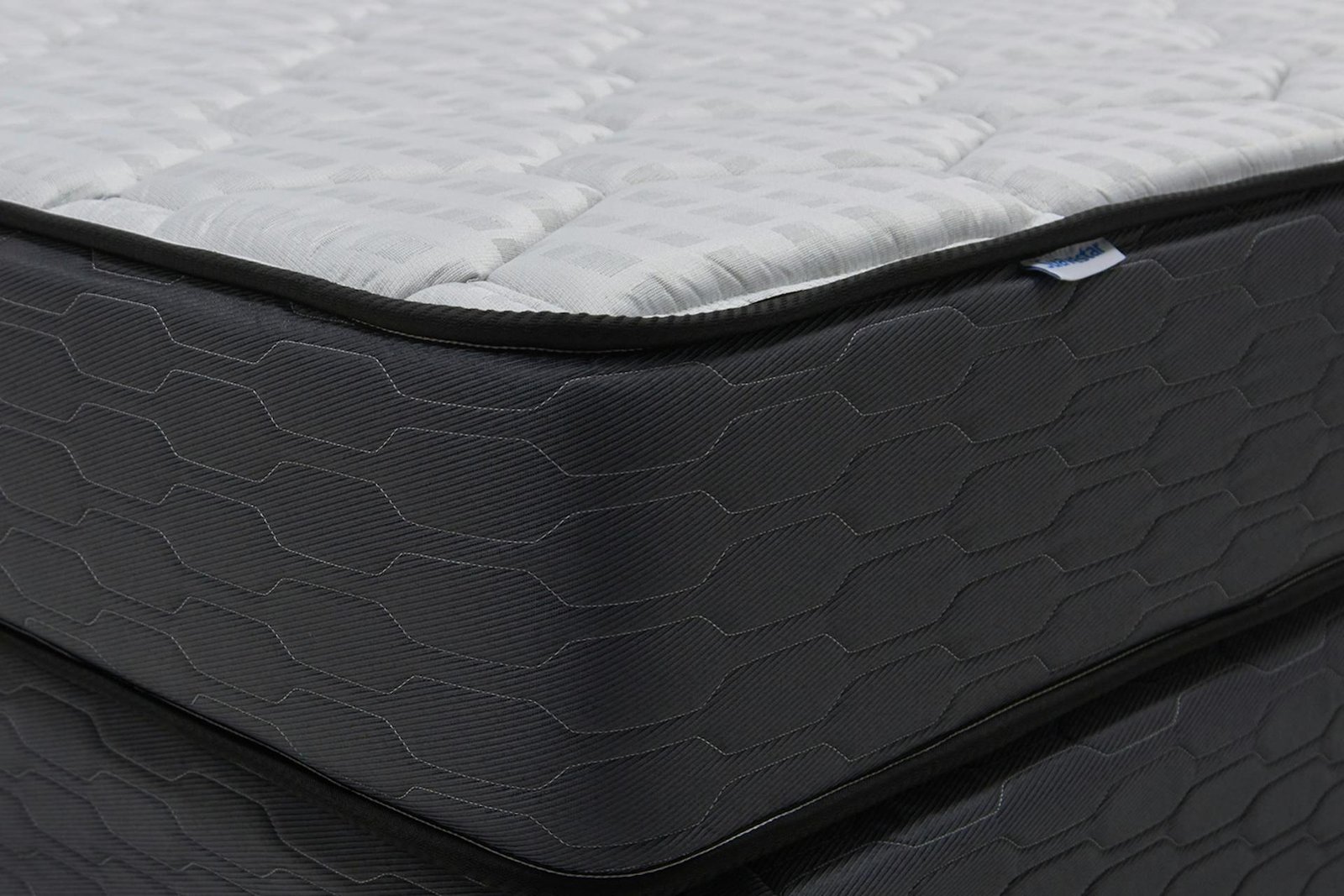
The tape-edge machine wraps a continuous binding tape around the junction of the top panel, border, and bottom panel, then drives a heavy chain-stitch needle through the full combined thickness — which at a mattress corner can include foam, fabric, a border rod, and multiple overlapping layers. The stitch this machine produces is the primary structural joint in the finished mattress; everything else — adhesive bonding, pocket coil welding, foam compression — supports it, but the tape edge holds the mattress together mechanically.
The corner is where tape-edging becomes genuinely difficult. As the machine advances around a 90-degree turn, material bulk increases sharply as layers overlap and the border tape folds. Pneumatic presser-foot systems with automatic pressure compensation maintain stitch tension through this variable thickness. On more automated machines, corner-turning is handled by a motorised repositioning mechanism that pauses the advance, pivots the mattress, and resumes sewing without operator intervention. Manual tape-edging, still common in smaller operations, requires a skilled operator to guide the mattress through the machine by hand — a technique that takes considerable practice to produce consistent results.
Beyond the tape edge, secondary sewing operations include attaching handles (typically bar-tacked in position through the border panel using programmable-pattern sewing heads) and, in high-end mattress production, hand-tufting or machine-tufting — where buttons or cords are driven through the full mattress depth to compress and stabilise the upholstery layers internally. Machine tufting presses are essentially heavy-duty sewing and fastening devices adapted for the unusual task of stitching through 25–30 cm of combined materials.
Latex: A Different Kind of Process
Natural and synthetic latex mattresses bypass the polyurethane chemistry entirely. In the Dunlop process, latex compound is whipped into a stable froth by a high-speed pin mixer, poured into moulds, and steam-vulcanised. The Talalay process adds two further steps after pouring: the sealed mould is put under vacuum to expand the froth evenly, then flash-frozen with CO₂ injection to lock the cell structure before vulcanisation. The freezing step must complete in seconds; specialist moulds with internal CO₂ distribution channels ensure even temperature across the full mould volume, preventing the latex from draining before the structure sets.
Roll-Packing and End-of-Line Handling
The bed-in-a-box market has driven widespread adoption of roll-pack machines that compress a finished mattress into a cylinder small enough to ship in a standard carton. The mattress is inserted into a vacuum bag, air is evacuated by large-displacement pumps — reducing thickness by up to 80% — and the compressed mattress is rolled and wrapped under continuous vacuum before the bag is heat-sealed. The process demands that foams have sufficient recovery to return fully to height after decompression, and that spring units are tempered to withstand the compression without permanent deformation. Not all mattress constructions are suitable for roll-packing, and this constraint has influenced the design of hybrid mattresses intended for this distribution channel.
End of Life: Mattress Recycling Machinery
As extended producer responsibility regulations tighten across Europe and elsewhere, mattress recycling has developed into its own specialist machinery sector. Industrial mattress recycling machinery is used on lines that incorporate a combination of shredding, mechanical separation, and material-specific recovery equipment to break down a mattress into its constituent streams. A pre-shredder reduces the whole mattress to manageable chunks; a rotary drum then separates the steel — springs and border rods — magnetically, while the foam, fibre, and fabric fractions are directed to secondary shredders or fibre openers. Recovered steel goes to steelmakers; shredded foam is processed into carpet underlay or acoustic panels; fibre fractions are compacted for use as industrial fill. Throughput rates on modern recycling lines can reach several hundred mattresses per shift, and the challenge — beyond material separation — is handling the huge variation in mattress construction from different manufacturers and different eras.
The Persistent Challenge of Scale and Flexibility
A mattress factory making a broad product range faces a structural tension: the machinery that produces consistent, high-volume output is most efficient running a single configuration, but the market demands dozens of sizes, firmness options, and construction types. The industry’s answer has been programmable CNC controls that allow rapid pattern and profile changes without mechanical tooling swaps, modular conveyor and handling systems that can be reconfigured between product lines, and a degree of manual assembly at the point where automation becomes impractical. Large, flexible, variable mattress components remain genuinely hard to automate completely, and even the most advanced plants maintain skilled operators at the quilting inspection stage, the tape-edge line, and final quality control.
Conclusion
The mattress is a product whose apparent simplicity conceals a manufacturing process of real technical depth. From the wire-drawing tolerances that determine spring consistency, through the chemistry of foam production, to the sewing machines that give a mattress its surface character and structural integrity, every stage involves engineering solutions to problems that are far from obvious until you examine them closely. The tape-edge stitch that runs around every mattress in your home was put there by a machine designed specifically for that one joint — and the quality of that stitch, invisible once the mattress is in service, determines how long the whole product holds together.