

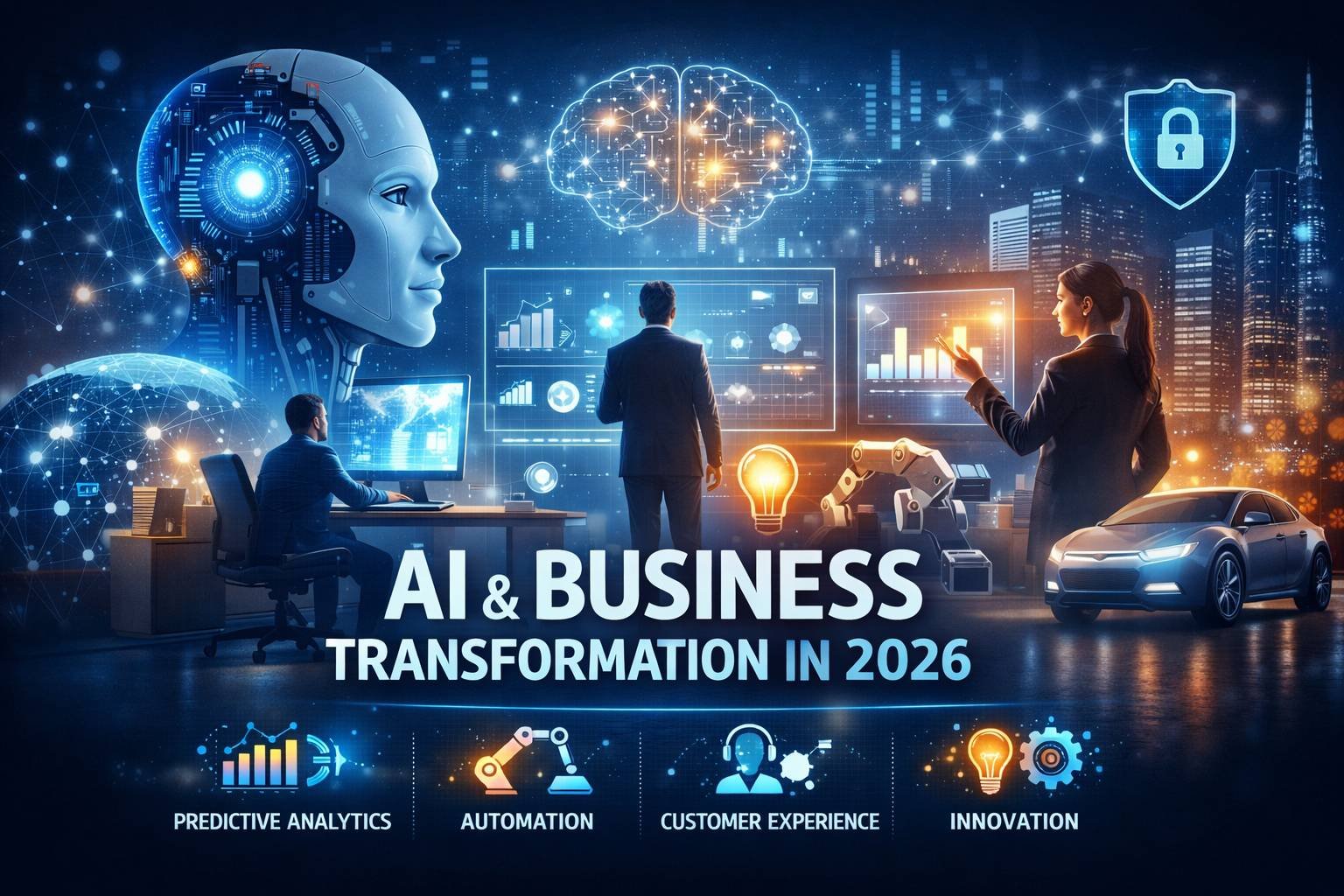
Artificial intelligence is no longer a distant concept reserved for technology labs. In 2026, it has become a practical tool shaping how companies operate, make decisions, and deliver value to customers. From predictive analytics and automated workflows to intelligent customer support and personalised marketing, AI is redefining what modern business efficiency looks like.
For organisations across industries, the shift toward AI is not just about innovation. It is about competitiveness. Businesses that adopt intelligent technologies are discovering new ways to improve productivity, understand customers, and operate with greater precision. At the same time, leaders are learning that the real power of AI lies in how it complements human insight rather than replacing it.
Understanding how artificial intelligence is transforming business today helps clarify where the future of work, leadership, and strategy is heading.
The Rise of Data-Driven Decision Making
One of the most significant impacts of artificial intelligence is the ability to transform raw data into meaningful insights.
Modern businesses generate enormous amounts of data from websites, sales systems, customer interactions, and digital platforms. In the past, analysing this information required extensive manual work. AI-powered analytics platforms now process millions of data points in seconds.
This shift allows organisations to make faster and more informed decisions.
Key advantages of AI-driven decision making include:
- Predictive analytics: AI models analyse historical patterns to forecast sales trends, demand cycles, and market shifts.
- Real-time insights: Businesses can monitor operations and performance continuously instead of waiting for monthly reports.
- Improved accuracy: Machine learning algorithms detect patterns that traditional analysis might miss.
As a result, executives can focus more on strategy while relying on intelligent systems to surface critical insights.
Smarter Customer Experiences
Customer expectations have evolved rapidly in the digital age. People now expect fast responses, personalised recommendations, and seamless service across channels. Artificial intelligence is helping businesses meet these expectations.
AI technologies power many tools customers interact with daily, including chatbots, recommendation engines, and virtual assistants.
These systems improve customer engagement in several ways:
- 24-hour customer support through AI chatbots that answer questions instantly
- Personalised product recommendations based on browsing and purchasing behaviour
- Voice recognition systems that simplify interactions through natural language
- Automated support routing that directs complex issues to the right human expert
For businesses, this means stronger customer relationships and more efficient service operations. For customers, it creates smoother and more intuitive experiences.
Automation of Repetitive Work
Many everyday business tasks are repetitive, time-consuming, and prone to human error. Artificial intelligence and robotic process automation are helping organisations streamline these activities.
Routine processes that once required hours of manual work can now be completed automatically. This includes tasks such as data entry, invoice processing, appointment scheduling, and basic document analysis.
Automation delivers several benefits:
- Higher operational efficiency
- Reduced administrative workload
- Lower operational costs
- Improved accuracy in routine tasks
Instead of replacing employees, automation often allows staff to focus on higher-value responsibilities like strategy, creativity, and problem solving.
AI in Marketing and Customer Insights
Marketing has become one of the most visible areas where artificial intelligence is making an impact.
Modern marketing platforms use machine learning to analyse customer behaviour, segment audiences, and optimise campaigns in real time. This allows companies to deliver the right message to the right person at the right moment.
AI-powered marketing tools support businesses through:
- Behavioural data analysis that reveals customer preferences
- Dynamic pricing models that adjust prices based on demand and market signals
- Automated advertising optimisation that improves campaign performance
- Content personalisation across websites and email marketing
These capabilities help companies move beyond broad marketing campaigns and toward highly targeted communication.
Strengthening Cybersecurity and Risk Management
As digital operations expand, cybersecurity has become a critical concern for modern organisations. Artificial intelligence is playing a growing role in protecting sensitive information and preventing cyber threats.
Traditional security systems rely heavily on predefined rules. AI-based security systems, by contrast, learn patterns of normal behaviour within networks.
When unusual activity appears, the system can detect and respond quickly.
Examples of AI in cybersecurity include:
- Threat detection systems that identify suspicious network activity
- Fraud prevention tools used in banking and e-commerce
- Behaviour analysis algorithms that detect account misuse
- Automated response mechanisms that isolate potential attacks
These technologies allow organisations to identify threats earlier and respond faster.
AI and Workforce Collaboration
A common misconception about artificial intelligence is that it replaces human workers. In reality, most modern businesses are discovering that the best results come from collaboration between humans and intelligent systems.
AI tools assist professionals by handling complex data analysis, generating insights, and supporting decision-making processes.
Employees benefit from AI support in areas such as:
- Project management tools that forecast timelines
- AI-assisted research and knowledge retrieval
- Design software that accelerates creative workflows
- Smart scheduling systems that optimise productivity
Rather than replacing human judgement, AI enhances it by providing better information and faster analysis.
The Rise of AI-Powered Innovation
Artificial intelligence is not only improving existing processes. It is also creating entirely new business opportunities.
Companies are now building products and services that rely directly on machine learning technologies. Examples include intelligent healthcare diagnostics, autonomous logistics systems, advanced financial forecasting tools, and personalised digital education platforms.
Innovation driven by AI is expanding into areas such as:
- smart supply chain management
- predictive maintenance in manufacturing
- intelligent financial risk modelling
- automated software development tools
As AI technology continues to evolve, businesses that embrace experimentation and learning will be better positioned to lead in emerging markets.
Responsible AI and Ethical Considerations
As artificial intelligence becomes more embedded in business operations, ethical considerations are becoming increasingly important.
Companies must ensure that AI systems operate fairly, transparently, and responsibly. This includes addressing issues related to data privacy, algorithmic bias, and accountability.
Responsible AI practices often involve:
- transparent data governance policies
- regular monitoring of AI decision models
- human oversight in critical decision processes
- compliance with data protection regulations
By prioritising responsible AI use, businesses can build trust with customers and regulators while protecting their long-term reputation.
The Future of AI in Business
Artificial intelligence is still evolving, and its role in business will continue to expand throughout the decade.
Several trends are likely to shape the next phase of AI adoption:
- wider use of generative AI in business operations
- integration of AI with Internet of Things systems
- increased adoption of autonomous decision-support tools
- growth of AI-powered productivity platforms
Businesses that invest in digital skills, strong data infrastructure, and responsible AI frameworks will be better prepared for these changes.
In many ways, AI is becoming part of the foundation of modern business operations. Companies that treat it as a strategic capability rather than a simple tool are more likely to gain long-term advantages.
Frequently Asked Questions
What is artificial intelligence in modern business?
Artificial intelligence in modern business refers to the use of machine learning, data analysis, and automated systems to improve operations, decision making, and customer service. These technologies analyse large volumes of data, identify patterns, and support businesses in making faster, more accurate strategic and operational decisions.
How are companies using AI in 2026?
Companies in 2026 use AI for customer support automation, predictive analytics, marketing personalisation, fraud detection, supply chain optimisation, and business intelligence. Many organisations also integrate AI tools into everyday workflows to assist employees with research, scheduling, data analysis, and operational planning.
Does artificial intelligence replace human workers?
Artificial intelligence typically supports rather than replaces human workers. Most businesses use AI to automate repetitive tasks while employees focus on creative thinking, strategy, and problem solving. This collaboration allows organisations to operate more efficiently while improving the quality of human decision making.
Which industries benefit the most from AI technology?
Industries benefiting most from AI include healthcare, finance, retail, logistics, manufacturing, and marketing. These sectors rely heavily on data analysis, customer interaction, and operational efficiency, making them ideal environments for machine learning, predictive analytics, and intelligent automation technologies.
How does AI improve customer experience?
AI improves customer experience by enabling personalised recommendations, instant chatbot support, and faster service responses. By analysing customer behaviour and preferences, businesses can tailor interactions, anticipate needs, and deliver more relevant products, services, and communication across digital channels.
What challenges come with AI adoption in business?
AI adoption presents challenges such as data privacy concerns, integration complexity, skills shortages, and ethical considerations. Businesses must invest in strong data governance, employee training, and transparent AI practices to ensure technologies operate responsibly while delivering reliable and trustworthy outcomes.