

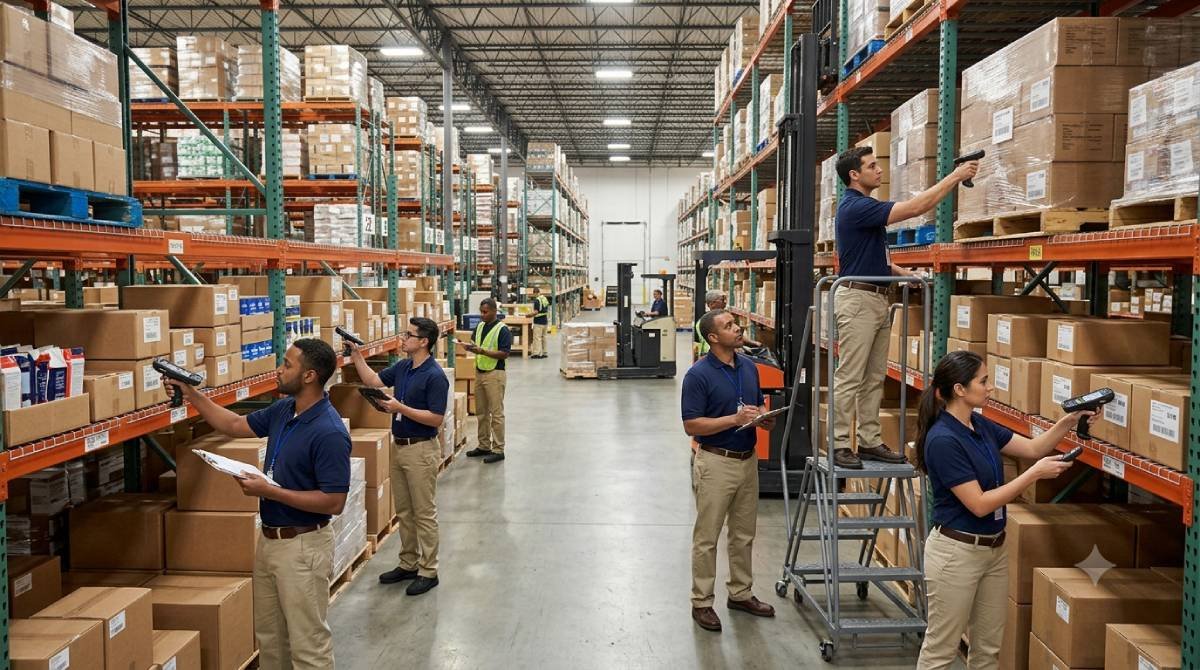
Full-service inventory counts usually come up in conversations about the annual wall-to-wall, though some of the strongest cases for handing an entire count to an outside team happen far from that routine. The 2026 calendar is full of them, from Coresight Research projecting as many as 8,228 U.S. store closures this year to a Halloween season that Spirit Halloween called the largest hiring event in its history, and the six situations below share one trait, which is a count that has to be right the first time with little or no help from the people who normally run the store.
Datascan’s full-service inventory count brings staffing, training, scanners, RFID equipment, software and analytics under one plan. Each scenario shows where that complete package earns its cost.
1. A Seasonal Pop-Up Store Closing After Its Peak
Spirit Halloween announced plans to hire more than 52,000 seasonal associates across more than 1,500 stores in the U.S. and Canada for 2026, and temporary retail operators like it face a count problem most permanent stores never see.
The selling season ends abruptly, the associates who staffed the store move on within days and every unsold costume, prop and animatronic has to be counted before it’s packed for storage, transferred or written down. A closing count run by a departing temporary crew carries obvious risk, since the people scanning have little stake in the result and may not return for a second shift if the count runs long. A full-service team arrives trained, counts on the operator’s timeline and delivers a verified number that becomes the starting inventory for next season’s planning, and the same logic applies to fireworks stands, holiday gift kiosks and any retail footprint designed to exist for only a few weeks.
The closing count also decides what happens to every unit next, so a full-service crew separates carry-forward stock from damaged display pieces and markdown candidates during the same pass. Datascan handles transfers and markdowns alongside the count, and its Enhanced Data Analytics scorecard lets an operator compare accuracy across hundreds of temporary locations run by different seasonal managers.
2. A Store Closing or Relocation With a Hard Lease Deadline
Coresight Research tracked 3,321 U.S. store closures in the first half of 2026 and projects as many as 8,228 for the full year, with GameStop, Francesca’s and Eddie Bauer among the retailers expected to close the most locations. Every closure ends with a lease return date, a fixture removal crew and inventory that has to be counted, allocated to other stores or sold through liquidation before the keys go back to the landlord. Relocations and full remodels follow a similar pattern on a tighter clock, since fixtures can’t come down until the merchandise on them is counted and the new space can’t open until transferred inventory is received and verified. A full-service count handles both ends of the move with zone-based counting, transfer documentation and carton audits, leaving the store team free to manage the move itself.
3. An Acquisition, Merger or Ownership Transfer
Retail deal activity has stayed busy through 2026, with Retail Dive’s running tracker noting that Etsy sold Depop, Reformation filed for an IPO and Bed Bath & Beyond made a series of acquisitions in the first half of the year, and Ameribrands announced its acquisition of Randal Retail Group in early October. Purchase agreements commonly tie part of the final price to inventory on hand at closing, which gives the closing count direct financial weight for both buyer and seller.
Neither party wants the other side’s employees producing the number that determines what changes hands. An independent full-service count gives both sides a figure they can accept.
Datascan’s SOC 1 compliance supports the documentation that attorneys, accountants and lenders review during the transaction, and its mobile app lets representatives from both companies follow the count as it happens from wherever they’re working. The count’s value continues well past closing day, since a buyer typically loads the closing figures into its own merchandising and ERP systems as an opening balance and any error in that number follows the business through its first year under new ownership. Datascan’s post-count reports and variance documentation give the integration team a clean record to reconcile against, and a follow-up cycle count a few weeks after closing can confirm the opening balance before the first financial statements under the new owner are prepared.
4. An Auto Parts Store With Thousands of Look-Alike SKUs
Auto parts counts punish inexperience, since a single store can carry brake pads, filters, sensors and gaskets in dozens of near-identical variations separated only by vehicle fitment or a digit in the part number, all stored in bins, drawers and overhead racks that make skipped locations easy and miscounts expensive. Core inventory adds another complication, because returned cores sitting in the back room carry value that has to be counted separately from sellable stock. A full-service team uses item look-up to confirm unfamiliar SKUs on the spot and works through bin locations systematically, producing a count that holds up when the next customer asks for a part the system says is on the shelf.
Many auto parts stores also serve repair shops and commercial accounts that expect fast delivery throughout the day, which makes closing the doors for a daytime count a hard sell. A full-service crew can work overnight or move through the store in zones while the counter stays open, and real-time monitoring lets the manager check progress between commercial orders.
5. An RFID Rollout That Needs a Clean Baseline
RFID delivers its accuracy gains only after a store’s tagged inventory matches its records. The first full count after tagging sets the baseline every future read depends on.
A study led by Professor Adrian Beck of the University of Leicester for GS1 UK and the ECR Community found that ten retailers and brands using RFID reached 93% to 99% inventory accuracy, while RFID Journal estimates item-level RFID adoption among the world’s apparel stores at under 10%, which leaves most retailers with their first baseline count still ahead of them. A baseline count involves more than scanning, including tagging untagged merchandise, validating read rates by department and reconciling the first RFID results against existing on-hand records. Datascan’s RFID implementation work pairs a full-service team with tags, handheld RFID readers and software, and leasing or rental options let a retailer complete the baseline without buying equipment outright.
Once the baseline holds, the same store can run future RFID counts with its own associates and call in supplemental staff only when volume demands it.
6. A Distribution or Fulfillment Center That Can’t Stop Shipping
Deloitte expects holiday e-commerce sales to reach $316.1 billion to $318.9 billion this season, and the distribution and fulfillment centers behind those orders rarely get a slow week to count. Shutting down a facility for a wall-to-wall inventory means missed ship dates, and counting around active operations requires a team that understands cross-docking, transient inventory in receiving and shipping lanes and the safety demands of a busy floor.
Datascan’s distribution center counting uses zone-based methods that let teams count specific areas while operations continue elsewhere, coordinates around receiving and shipping schedules and supports direct data transfer to major warehouse management and ERP platforms. Returns processing adds another layer, since Appriss Retail estimated $706 billion in merchandise was returned in 2025, and returned goods sitting in processing areas have to be counted and categorized correctly before they can be resold. A full-service team that verifies returns alongside the main count closes a gap that’s hard to cover with a crew already working peak shifts.
Keeping the count in outside hands also keeps the facility’s own leads focused on outbound volume during the weeks that matter most.
Choosing Full-Service Over Supplemental Staff
Not every count needs a full-service team, and a store with strong procedures and a temporary labor gap can run a hybrid count by adding Datascan’s supplemental staff to its own associates while keeping control of the process. The six situations above call for more, since each involves a hard deadline, a risk of dispute, a technical baseline or an environment where an inexperienced crew costs more than outside help. Datascan’s full-service package brings the people, equipment, RFID technology, software and a dedicated Customer Success Manager together under one plan, and a consultation can map which of these scenarios matches the next count on the calendar.